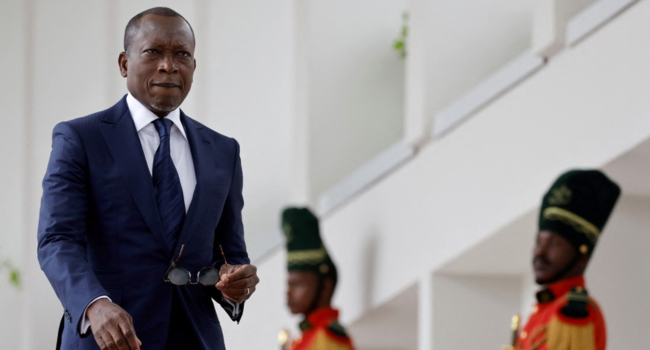
BeninâÂÂs President Patrice Talon has assured citizens that the country is âÂÂcompletely under controlâ after loyalist forces, backed by rapid military support from Nigeria, successfully crushed an attempted coup on Sunday. The failed rebellion began early in the day when a group of soldiers seized state television and announced that they had removed Talon from office.
The attempted takeover triggered an immediate and forceful response from BeninâÂÂs regular army, which swiftly moved to regain control of key installations in Cotonou. Nigeria, acting on an official request from BeninâÂÂs foreign ministry, deployed fighter jets and ground troops in support of the loyalist effort. A senior Nigerian presidency source confirmed that Nigerian aircraft struck undisclosed targets as Beninese forces pressed forward with countercoup operations.
Beninese military and security insiders reported that around a dozen soldiers had been arrested so far, including those believed to have orchestrated the coup attempt. The soldiers identifying themselves as the âÂÂMilitary Committee for Refoundationâ (CMR) appeared on state TV on Sunday morning, proclaiming Lieutenant Colonel Pascal Tigri as the new leader and citing grievances over worsening insecurity in northern Benin, neglect of fallen soldiersâ families, and unfair military promotions.
However, just hours after their televised declaration, a source close to President Talon confirmed that the president was safe and described the mutineers as âÂÂa small group of people who only control the television.â The source added that loyalist forces were steadily reclaiming the capital, noting that âÂÂthe city and the country are completely secureâ and that the clean-up operation was progressing.
By evening, Talon himself appeared on state broadcaster Benin TV to reassure the population. âÂÂThe situation is completely under control,â he said, urging citizens to resume their normal activities. His message came after Interior Minister Alassane Seidou announced that the armed forces had âÂÂmaintained control of the situation and foiled the attempt.âÂÂ
Despite the governmentâÂÂs assurances, the atmosphere in Cotonou remained tense earlier in the day. AFP correspondents reported gunfire near the presidential offices, which, along with state TV headquarters and several key districtsâÂÂincluding areas housing international institutionsâÂÂwere blocked off by soldiers. Other parts of the city, however, experienced little disruption, with residents continuing their daily routines.
Some locals described the events as frightening. âÂÂWe had a few scary moments,â said retired teacher Jennifer Adokpeto, who initially feared the country might follow the path of its neighbours that recently fell to military coups. Street vendor Adam Aminou expressed relief that the coup was foiled but called for deeper reforms to prevent future instability.
The Economic Community of West African States (ECOWAS) announced that standby troops from Ghana, Ivory Coast, Nigeria, and Sierra Leone were being deployed to assist Benin in preserving constitutional order. The African Union, United Nations Secretary-General Antonio Guterres, France, and the Organisation of La Francophonie (OIF) all issued strong condemnations of the attempted coup.
The incident marks another troubling chapter in a region already shaken by a wave of military takeovers in Niger, Burkina Faso, Mali, Guinea, and Guinea-Bissau. Benin, historically more stable, has recently faced increasing jihadist pressure in its northern territories.
President Talon, 67, a prominent businessman before entering politics and widely known as the âÂÂcotton king of Cotonou,â has led Benin since 2016. His administration has presided over significant economic growth, though critics regularly accuse him of authoritarian tendencies. He is expected to complete his second and final constitutional term in 2026.
As Benin returns to a semblance of calm, questions remain about the depth of discontent within its military ranks and how the government intends to prevent future threats to its hard-won democratic order.
News
Talon Declares Benin “Completely Under Control” After Failed Coup Backed by Mutinous Soldiers
Benin’s President Patrice Talon has assured citizens that the country is “completely under control” after loyalist forces, backed by rapid military support from Nigeria, successfully crushed an attempted coup on Sunday...